Largo, FL · Garage Door Service
Seminole homes cluster around 1979 builds, just inside Largo's 1958-2001 range. We travel the 4 miles from Largo for torsion spring, track, and opener work on that era's doors.
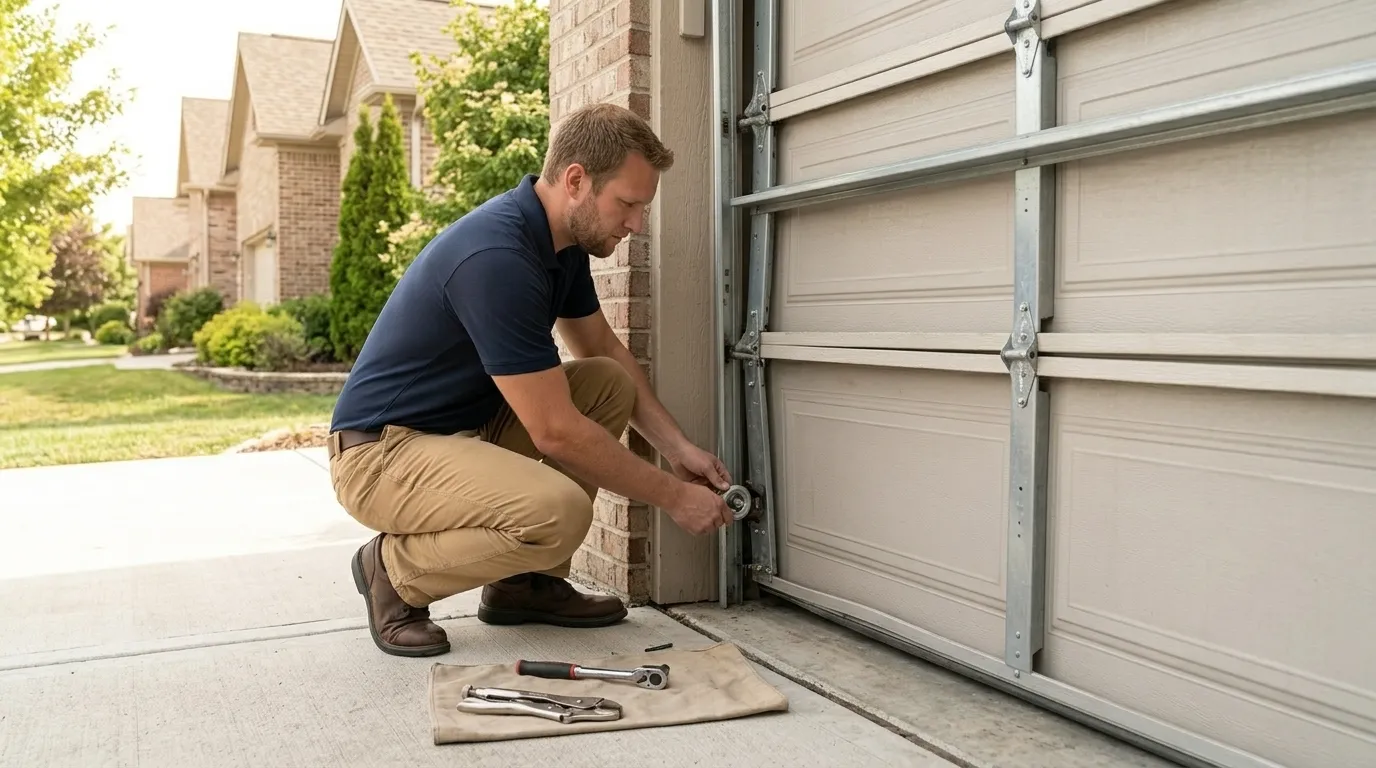
Seminole's housing stock centers on 1979, which puts most of the doors we see here at the tail end of the builder-grade steel door era. That means original torsion springs wound on the same cones the house shipped with, and a lot of single-layer steel panels that have taken forty-plus years of mild-but-humid Gulf air. The most common call is a broken torsion spring on one of these original setups - the coil finally gives out after decades of cycling, and the door won't lift or slams down hard. Second most common: openers from a later retrofit that don't match the original track hardware, so the chain binds or the trolley skips. We also get a fair number of roller and cable jobs, since steel rollers from a 1979 install have usually worn well past their life by now. Full replacement comes up too, but less often than in newer subdivisions - a lot of Seminole owners are keeping the original opening and just swapping the panel and springs rather than reframing.
With a median build year of 1979, Seminole sits right at the modern edge of the broader 1958-2001 range across the service area, but it leans toward the same 1960s-70s construction habits as most of the surrounding neighborhoods. Roughly 8,989 households call this area home, and the median household income here, $77,335, runs noticeably below the wider service area's $93,862. That gap shows up in the calls we get: more owners asking us to fix what's there before they price out a full replacement, and more original hardware still in service instead of already swapped out. The mild temperate climate here hasn't been hard on the doors in the way a freeze-thaw region would be, but forty-plus years of humidity does its own slow damage - rust at the bottom panel seams, hinges that have lost their zinc coating, and wood-look doors from that era where the composite skin has started to separate from the frame.
A door installed around 1979 was built before a lot of the safety standards homeowners assume are already there. Openers from that period, or first-generation retrofits onto that period's track, often lack the photo-eye reversal sensors that became standard later - if yours still has none, that's worth flagging even if the door itself works fine. The torsion spring setups from this era were sized for the original steel panel weight, so if a previous owner added insulation or swapped in a heavier door without re-rating the spring, you get a door that's hard to lift by hand and hard on the opener motor. Track width and drum sizing also varied more in the late 1970s than they do today, which means a modern off-the-shelf spring or cable doesn't always bolt straight onto a Seminole-era bracket without an adapter or a full hardware swap. We check the actual cone and drum before quoting, not just the door size.
We run out of Largo, and Seminole is a short trip - about 4 miles out. That's close enough that a same-day call doesn't mean a long wait behind other jobs, since it's one of the nearer stops on the route rather than a detour. We don't keep a stocked location in Seminole itself; every truck comes loaded from Largo, so if a job needs a part we don't carry standard - an odd-sized vintage panel, say, or a spring cone that's no longer a common size - there can be a short lead time to get it in. We'd rather tell you that upfront than promise a same-visit fix we can't back up.
Most likely a weakening torsion spring - normal after decades on an original 1970s-era setup. Springs lose tension gradually, so the door gets a little harder to lift by hand or a little slower to rise each year until it finally won't move. It's a spring swap, not usually a full door replacement.
If it was installed with the original door around 1979 or shortly after, it may predate the photo-eye sensor requirement that later became standard. We check for sensors on every service call and can tell you plainly whether yours meets that basic safety standard or not.
No - we run out of Largo, about 4 miles away, and load the truck from there. Most jobs go fine with standard stock, but an odd-sized vintage part occasionally needs a short order lead time before we can finish the job.
Depends on the panel condition more than the age alone. If the steel is sound and it's a spring, cable, or roller issue, repair usually makes sense. If the panel's rusted through at the seams or the track is bent past straightening, replacement is the better money.
Call now or request a free quote - same-day service on most repairs, upfront written pricing.
